The Universal Individual-Based Model (UIBM)

Final Version


A joint project of the

Institute for Plant Ecology,

Department of Biology, Chemistry and Earth Sciences

Justus-Liebig-University Giessen, Germany

and the

Department of Mathematics, Natural Sciences and Computer Science,

University of Applied Sciences Giessen-Friedberg, Germany


Model Description

1. Overview

We are in a phase of a dramatic, unprecedented loss in biodiversity on earth (1,2). The direct drivers of biodiversity loss are land cover change (1), habitat change (1), invasive alien species (1), pollution by excessive usage of synthetic nitrogen fertilizer (1,3) and by nitrogen deposition from the atmosphere (4), global climate change (1,3,4), and rising atmospheric carbon dioxide levels (4). In principle, phytodiversity loss, i.e. the decline in plant species richness, is a crucial component of the man-made biodiversity loss.


1.1 Model Purpose

UIBM will be an agent-based discrete-event simulation model of the dynamics within multi-species plant communities. The aim of the Universal Individual-Based Model is to provide a modeling tool for understanding and prediction of phytodiversity loss in Northwest Europe. To achieve this goal the plant dynamics will be parameterized using information on persistence, regeneration and dispersal contained in species traitbases (6-11). It is assumed that shifts in species abundances are a result of altered competition for resources on a local scale and that these local dynamics are translated to a regional scale with some modification due to dispersal effects.


1.2 Current Model Structure, State Variables and Scales

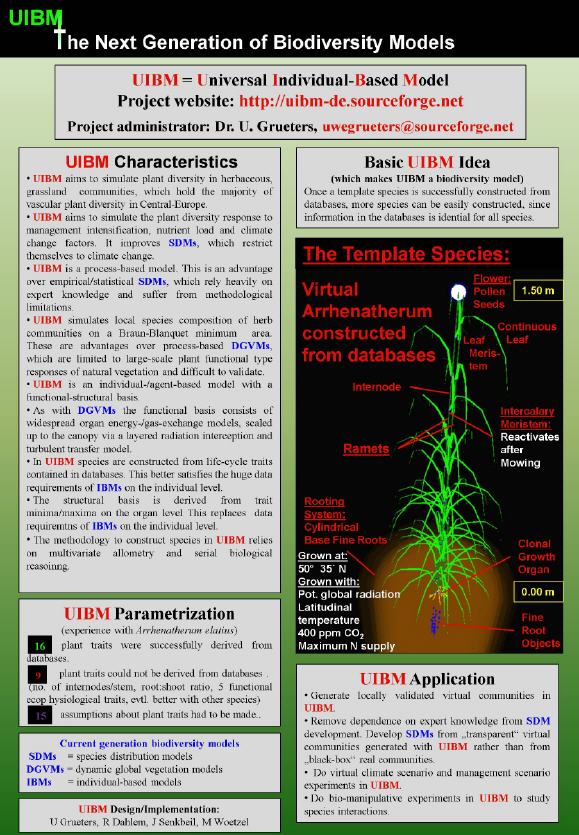
We have begun to construct the architecture of a template species, i.e. false oatgrass (Arrhenatherum elatius), mainly from online species traitbases of the Northwest European Flora. Due to its development along traitbases, in principle, the model is extensible to the whole set of herbaceous species contained in those databases.

We have used Java together with the Multiagent Simulation Toolkit MASON (5) for the model development.


The main structure of the model is as follows:

1. Composite Pattern (according to 24) for the plant components:


abstract superclass PlantComponent

(instance variables: location, direction, rollPitchYaw)

                                               â                                                    â

abstract superclass: PlantStructComponent                              concrete subclass Meristem 

(dry mass, carbon/nitrogen concentration, content)                  (meristem type)

â

concrete subclasses

Vegetation, PlantIndividual,

Plant (newly attained carbon/nitrogen per day, since last organ creation step),

BaseCoarseRoots (diameter/depth of rooting system),

BaseFineRoots (diameter/depth of rooting system),

CoarseRoots, FineRoots (tissue density, nitrogen concentration, specific root length), ClonalGrowthOrgan, Internode (length/diameter, volume fraction of living tissue in hollow

           organs, density of living tissue, tissue density)

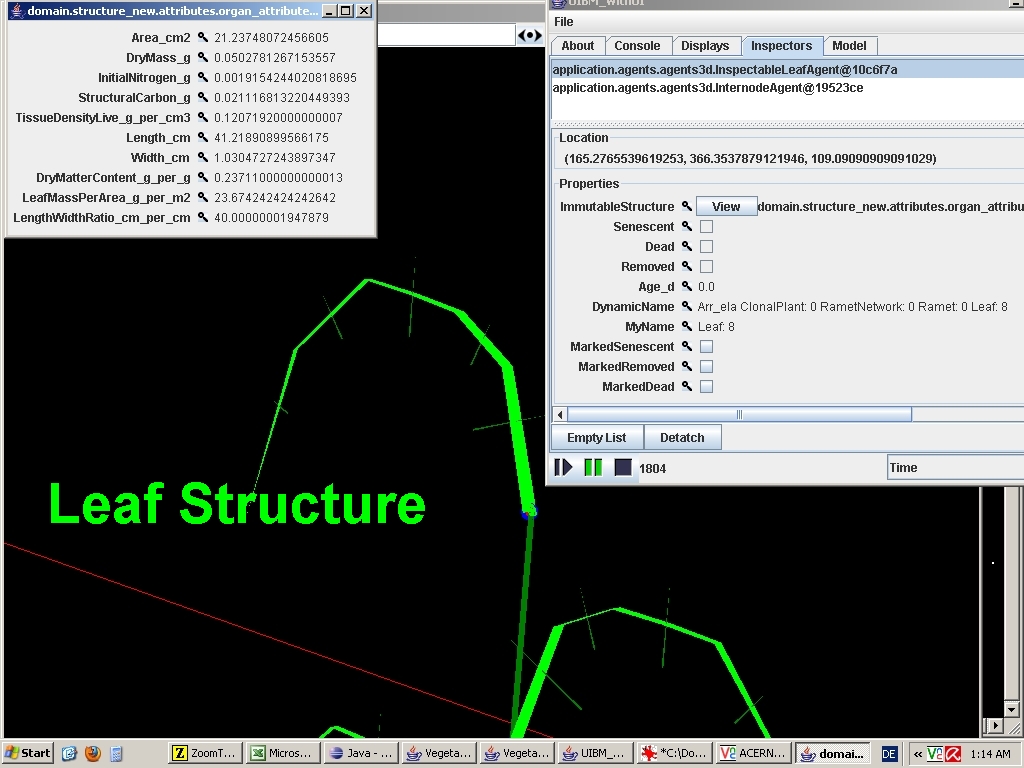
Leaf (length/width, dry matter content, tissue density, thickness, leaf mass per area, area), Flower (number of pollen, number of seeds)

Pollen (number of pollen),

Seed


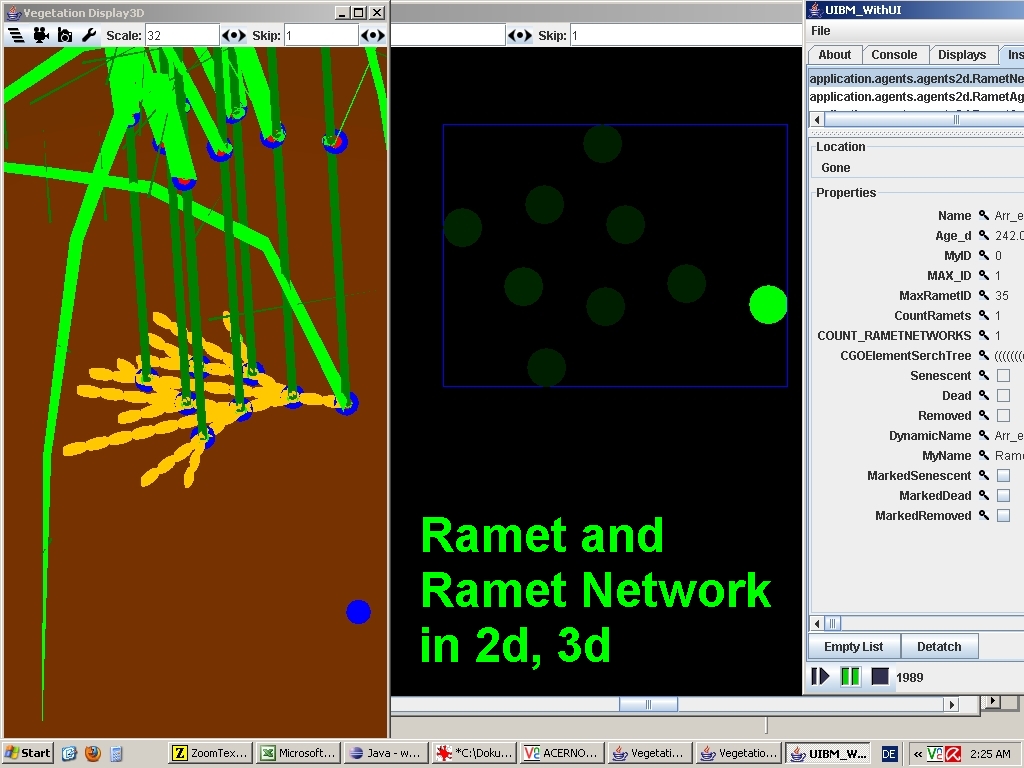
Within UIBM plants are modeled as ramets composed of internodes, leaves, coarse/fine root systems, and flowers with pollen/seeds. Plants are connected by clonal growth organs and the so-linked plants form a clonal plant individual. All these concrete structural plant components possess dry mass, carbon/nitrogen content as state variables. The various plant organs do have additional state variables that are listed in the simple class diagram shown above. The meristems of the various types, representing points of leaf/internode/flower growth on the plant, are modeled mass-less, so the Meristem class is a direct subclass of PlantComponent.


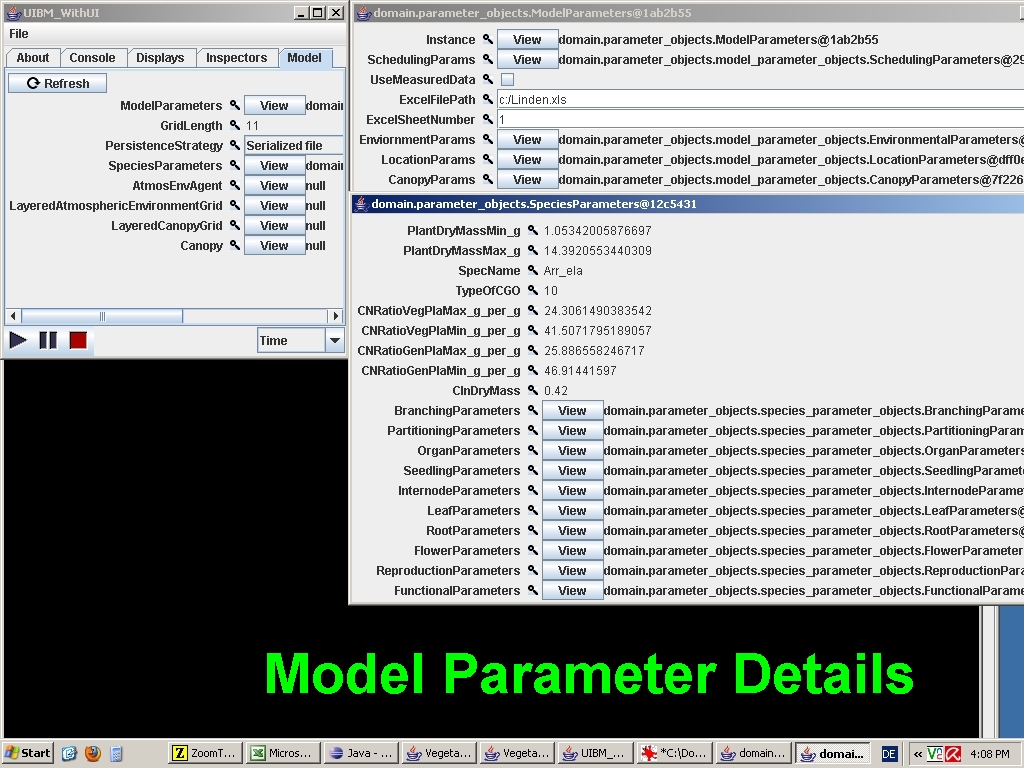
2. Data Transfer Objects transporting species-specific information from the parameter database (a Properties-like text file) to the plants/internodes/roots: class SpeciesInfo (general information related to the species), class AllocationInfo (state-dependent information related to carbon allocation among foliage, stem, clonal growth organ, coarse roots, fine roots), class BranchingInfo (state-dependent information related to meristem numbers per phytomer and meristem angles), class RootingInfo (information related to the rooting system)

The parameters are mostly derived from traitbases (6-11), but also make usage of trait information for a range of species contained in scientific publications (12,16,19).


3. State Pattern representing behavior that varies with the ontogenetic stage of the plant: interface StateInterface, abstract superclass State, subclass AccumulateToCotylState, subclass CreateCotylState,…


The implemented methods compute carbon/nitrogen allocation to organ types and subsequently to individual organs, calculate the attributes of the new organs, and decide whether sufficient resources are available to create new organs in a state-specific manner. In general, accumulative and creational states alternate over time. The initial state of a plant is set to an accumulative state (AccumulateToCotylState) that leads to the formation of cotyledons, i.e. the first leaves of the seedling (CreateCotylState). Plants are entering a flowering state, when the month of flowering start given in the databases is reached and the dry mass at that time is larger than the minimum mature plant dry mass.


4. Data Transfer Objects mediating between plants and their organs to be created: class AttributesNewLeaf, class AttributesNewInternode,….


The attributes of the organs to be created are dependent on newly attained carbon/nitrogen after applying a linear carbon allocation scheme and reducing maximum organ nitrogen concentrations (obtained from 16, 17) until the N demand matches N supply to the plant. The various attributes for each plant organ are found applying so-called “universal” scaling laws, i.e. power law allometric relationships (14,15, using 16,17 and helper functions of 18) to interpolate between minimum/maximum attributes. In principle, it is assumed that minimum organ sizes are realized with minimum organ N concentration. The Attributes objects transfer the set of instance variables to the respective organs.


In general, UIBM shall simulate the dynamics of a multi-species plant community in a 4 x 4 x 3 m micro-world, a virtual vegetation survey plot, so to say. The time scale currently used is 1 day. The temporal extent is considered to be in the order of one or two decades.

1.3 Process Overview and Scheduling: Present and Future

Currently, we are testing the accumulation and creation routines using a universal scaling law (13) as growth function. The function is parameterized with seedling growth rate and maximum/minimum plant dry mass specific to the template species. The nitrogen supply is set to its minimum/maximum. At present, simulation time proceeds in steps of 1 day. So far, the processes taken into account are:

1.           Aboveground/belowground carbon allocation (linearly interpolated between the maximum/minimum ratio of newly attained carbon to newly attained nitrogen)

2.           Carbon partitioning between foliage and stem (linearly interpolated between maximum/minimum plant new C/new N ratio)

3.           Carbon partitioning between internode and clonal growth organ (assumed to be constant)

4.           Matching organ N concentrations to the plant N-supply and adjusting organ attributes accordingly

Besides that, a group of us is working on the 2d visualization of the scene and on a 3d-visualization of the plant architecture with computer-designed leaves and internodes, clonal growth organs and rooting systems displayed as cylinders. The 3d-visualization will make extended usage of the Java3d capabilities available in MASON.


Merely a tentative outline of processes to be implemented in the future shall be given here:

  1. Light Interception submodel

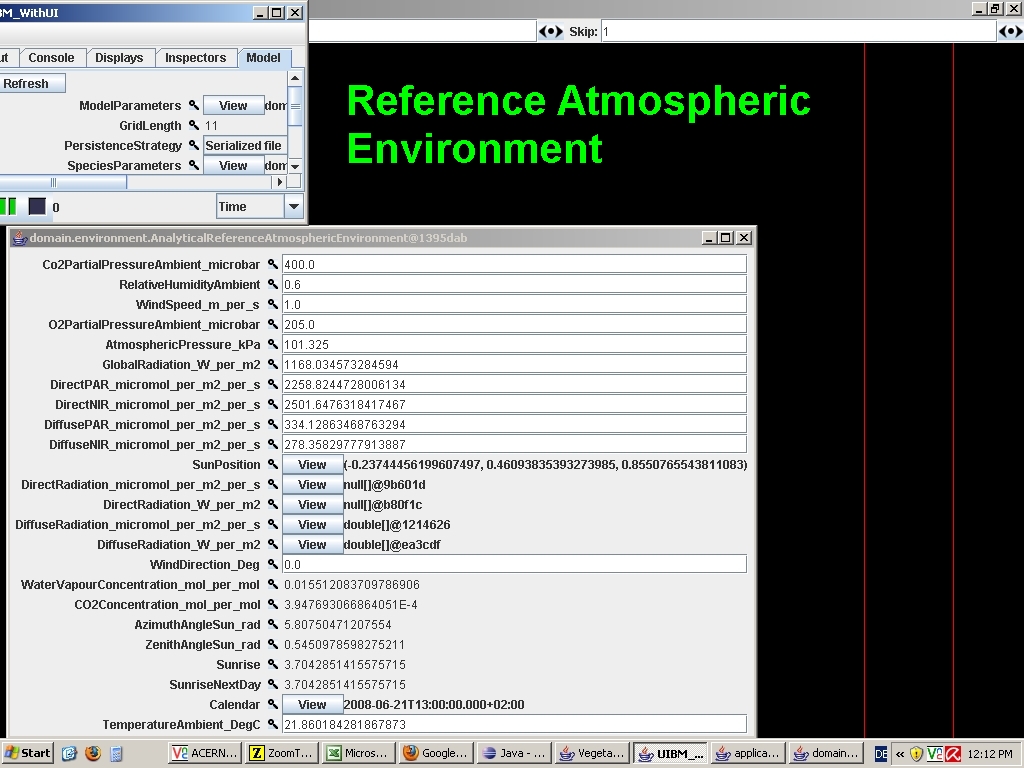
A light interception model is an important prerequisite for cutting the dependence on the growth function and making the leaf “structure” functional. The code we have already obtained from M. Roehrig might serve as a suitable source for this task (20). Since Roehrig’s light interception model calculates he light regime within the canopy on a several-hour basis, a corresponding reduction of the simulation time step is necessary. Functions for day length and direct/diffuse potion of the sunlight have to be implemented.

2. Gas exchange submodel

A prototype for the leaf part of this submodel including the Farquhar & von Caemmerer photosynthesis description (21) and transpiration has already been written. Since light, temperature and relative humidity of the air are the driving forces to his submodel, they have to be included. The computation of respiratory carbon losses imposed by the various organs will be computed from their actual N concentrations, the local temperature and some portion of the remaining carbon input. In order to integrate these processes all organs have to implement a gas-exchange interface. At the end of each day the results of the organ-specific carbon budgets have to be pooled at the plant level. Hence, updating of the newly attained carbon must pursue in the scheduling order.

3. Water-/Nitrogen-uptake submodel

This submodel shall enable the rooting system to take up substances within the covered soil volume thereby making root structure likewise functional. Competition among rooting systems will be solved by a supply/demand routine. The BaseFineRoot class has to implement a corresponding interface. Consequences to the scheduling are similar to those of the gas-exchange process (see above). Precipitation has to be added as an environmental factor and water potential has to be added to the state variables of an organ.

4. Organ lifespan submodel

As in (25) the lifespan of the various organs will be made dependent on their N concentration and the density of the living tissue. When an organ is supposed to die it will likely make part of its nitrogen content available to the newly attained nitrogen of the plant before carbon allocation is scheduled.


Comparison with other modeling approaches

The completed model will differ from most individual-based plant growth models (e.g. the JABOWA/FORET/SORTIE model family, see 22) by integrating competition for all above-/belowground resources. UIBM will be similar to the LEGOMODEL (23) with respect to its foundation in database-derived parameters. Nonetheless, UIBM will be much closer in appearance to the functional-structural type of plant growth models. Major differences to similar approaches will lie in the application of scaling laws to derive organ attributes and the model being developed with a standard Agent-Based Modeling toolkit.


References:

1. Millennium Ecosystem Assessment (2005): Ecosystems and Human Well-being: Biodiversity Synthesis. World Resources Institute, Washington, DC.

2. Nature Insight (2000): Biodiversity Nature Vol. 405, No. 6783

3. Sala O.E. et al. (2000): Review: Global Biodiversity Scenarios for the Year 2100. Science Vol. 287. no. 5459, pp. 1770 - 1774 

4. Thomas C.D. et al. (2004): Extinction risk from climate change. Nature 427, pp. 145-148

5. Multiagent Simulation Toolkit MASON: http://cs.gmu.edu/~eclab/projects/mason/

6. Kleyer M. et al. (in prep.): The LEDA Traitbase: A database of plant life-history traits of North West Europe. (online at: http://www.leda-traitbase.org/LEDAportal/)

7. Klimešová J. & Klimeš L. (2006): CLO-PLA - a database of clonal growth in plants (online at: http://www.butbn.cas.cz/clopla/ )

8. Flynn, S., Turner, R.M., and Stuppy, W.H. 2006. Seed Information Database (release 7.0, October 2006) http://www.kew.org/data/sid

9. Buchner R. & Weber M. (2000 onwards). PalDat - a palynological database: Descriptions, illustrations, identification, and information retrieval. http://www.paldat.org/

10. Fitter A.H. & Peat H.J. (1994): The Ecological Flora Database. Journal of Ecology 82, pp. 415-425 (online at: http://www.york.ac.uk/res/ecoflora)

11. Klotz S. et al. (2002): BIOLFLOR – Eine Datenbank mit biologisch-ökologischen Merkmalen zur Flora von Deutschland. Bundesamt für Naturschutz

12. Roulston T.H. et al. (2000): What governs protein content of pollen: pollinator preferences, pollen pistil interactions, or phylogeny? Ecol. Monogr. 70, pp. 617–643

13. West G.B., Brown J.H. Enquist B.J. (2001): A general model for ontogenetic Growth. Nature Vol. 413, pp. 628-631

14. Wright I.J. et al. (2004): The worldwide leaf economics spectrum. Nature Vol 428, pp. 821-827

15. Niklas K.J. (1995): Plant Height and the Properties of Some Herbaceous Stems. Annals of Botany 75: pp. 133-142

16. Thompson K. et al. (1997): A comparative study of leaf nutrient concentrations in a regional herbaceous flora. New Phytologist, Vol. 136, No. 4 pp. 679-689

17. Whtehead D.C. (2000): Nutrient Elements in Grassland. CABI Publishing

18. Shipley B. & Vu T. (2002): Dry matter content as a measure of dry matter

concentration in plants and their parts. New Phytologist Vol. 153 Iss. 2, pp. 359

19. de Jong M. (2003):Reaktionen von drei Süßgrasarten mit unterschiedlichen Nährstoffansprüchen auf erhöhte NH3-Konzentrationen und NH4+-Gaben in Rein- und in Mischkultur. Ph. D. Thesis, Justus-Liebig-University Giessen

20. Roehrig M. et al. (1999): A Three-Dimensional Approach to Modeling Light Interception in Heterogeneous Canopies. Agronomy Journal 91: pp. 1024-1032

21. von Caemmerer S. (2000): Techniques in Plant Sciences Vol. 2: Biochemical Models. CSIRO Publishing

22. Deutschman et al. (1997): Scaling from Trees to Forests: Analysis of a Complex Simulation Model. Science Online (http://www.sciencemag.org/feature/data/deutschman/index.htm )

23. Lehsten V. (2005): Functional analysis and modelling of vegetation. Ph.D. thesis, Carl von Ossietzky Universität Oldenburg

24. Gamme E. (1995): Design Patterns. Elements of Reusable Object-Oriented Software. Addison Wesley Longman

25. Moorecroft P.R. et al. (2001): A Method for Scaling Vegetation Dynamics: The Ecosystem Demography Model (ED). Ecological Monographs, Vol. 71, No. 4, pp. 557-585


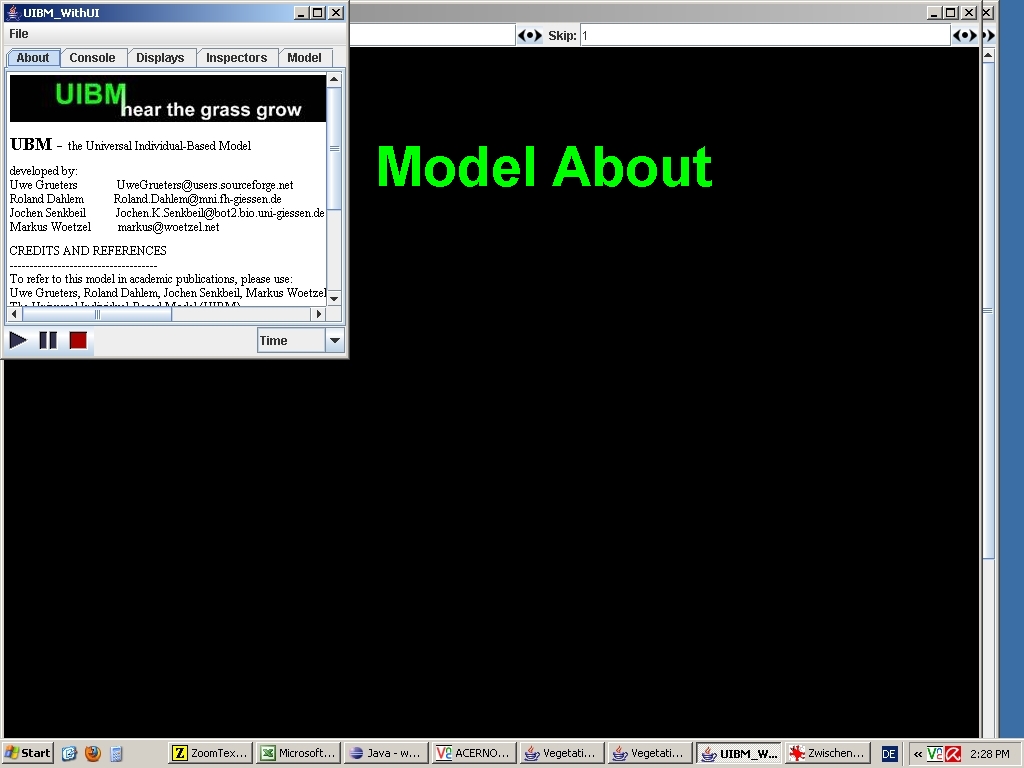
CREDITS AND REFERENCES

----------------------------------------

To refer to this model in academic publications, please use:

Uwe Grueters, Roland Dahlem, Jochen Senkbeil, Markus Woetzel (2007):

The Universal Individual-Based Model (UIBM). 

http://sourceforge.net/projects/uibm-de  


In other pudeblications, please use: © Copyright. April 20, 2007.

Uwe Grueters, Roland Dahlem, Jochen Senkbeil, Markus Woetzel.

Some rights reserved.

See http://sourceforge.net/projects/uibm-de for terms of use.


Get UIBM at SourceForge.net. Fast, secure and Free Open Source software downloads